

Dry As Salt

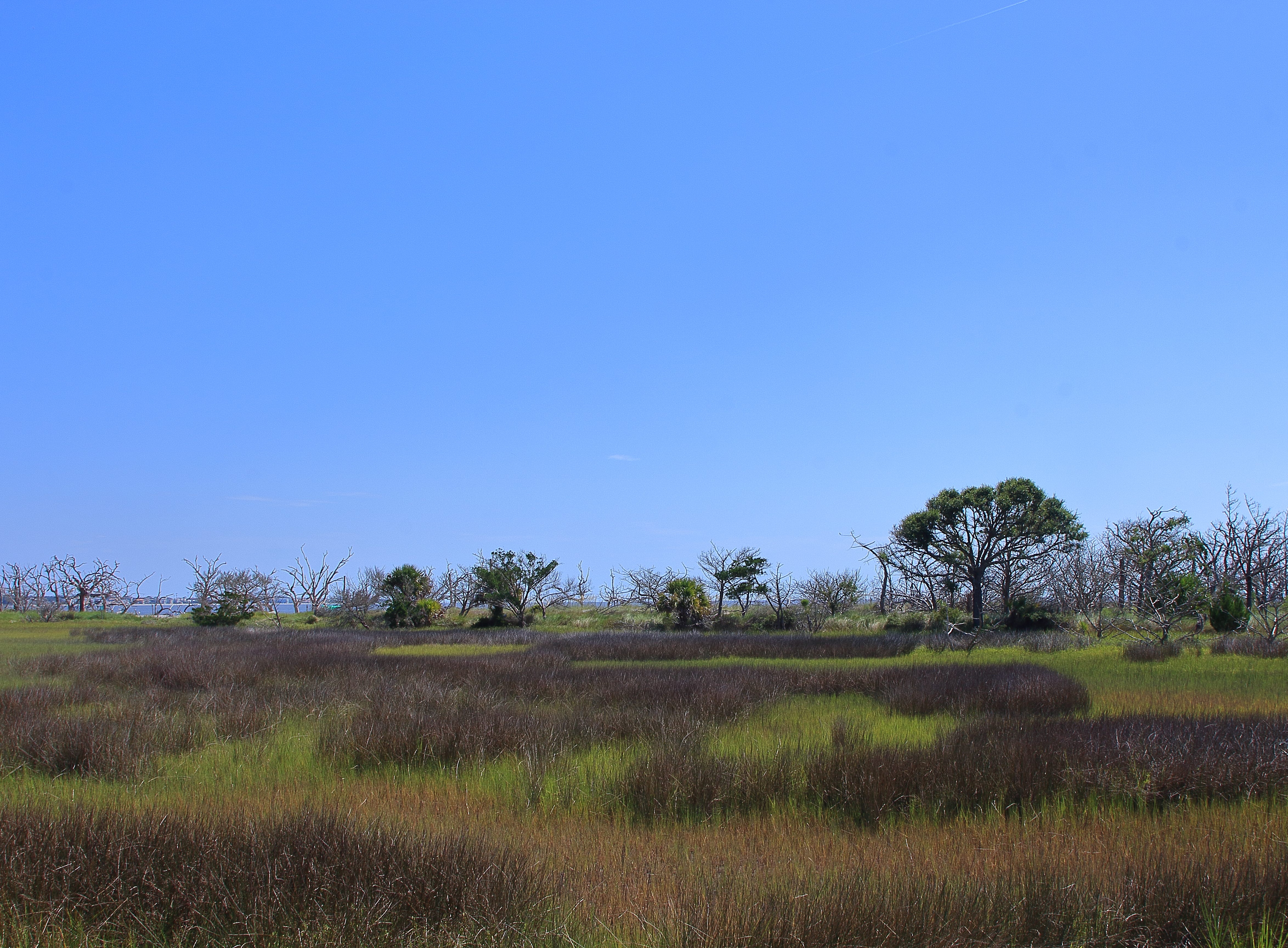
July 26, Jekyll Island— Beach View Drive crosses a peninsula of desiccated marsh. Amid cars, I parked just off Beach View Drive to visit Driftwood Beach. The moment I stepped out steaming, dense air suffocated me. I reached out with both hands and squeezed fistfuls of air. Droplets dripped from my fingers. Salt coated my palms. It’s dry. Dry as salt as the marsh grasses burn. An aerial view suggests the creek running through here is a ghost of itself.
The day before I crossed the rivers Ogeechee, Jerico, and mighty Altamaha. Their seasonal flow was down. Crossing the Intracoastal Waterway—the Big Ditch—salt marshes rippled green as ever. High grasses. Low tide. A land of contrasts. And so is Driftwood Beach. I walked the trail to fallen trees. A park ranger on a bicycle greeted me. “Keep your eyes open. We have a painted bunting here.” She pedaled off.
Good to know. I’ve seen an indigo bunting but never a painted bunting.
It wasn’t a good time to photograph Driftwood Beach. The sun rode high. Harsh light. Dark shadows. Glare. Contrast of another kind. Even so, the boneyard commanded the eye. And not just mine. Tons of people here on this scalding Sunday. Too many. I left.
Before I left, I photographed the dry marsh. I’ve noticed a good many dry marshes over the last several years. I’m no marsh expert but it seems for whatever reason they suffer a lack of flow. Water, water everywhere and not a drop to drink. That’s the way Samuel Taylor Coleridge would put it. I’m not sure if it’s a seasonal dormancy thing. Seems too early. Fall is a ways off. Could be something to do with tidal action. Maybe. I didn’t see any wrack either, that accumulation of dead marsh stalks whose mats smother living marsh. Perhaps the answer lies in salinity levels. The right kind of scientist would know.
Estuaries seem rich with life and they are. An acre of smooth cordgrass ranks as one of Earth’s more productive natural habitats. Check out the estuary at low tide. You’ll see ample evidence of life and death.
I’ve long admired green spartina. It seems drought-proof but not identity-proof. Scientists changed spartina’s name based on DNA studies. Spartina’s new name is Sporobolus, more accurate but nowhere as poetic. “Spartina” trips off the tongue quite smoothly. “Sporobolus” stumbles. It’s hard to remember.
My photograph of the dry marsh reveals distant trees killed by saltwater and slivers of green amid the brown, dried-out marsh. Here and there dead trees as white as bones do in fact bring bones to mind. In the distance the blue Atlantic seems to flow right into the sky. A handful of deep-green conifers lord over the grasses—brown and green. All in all, it’s an alluring scene, a portrait of life in a harsh place.
The interface between the continent and the sea, it’s dynamic. The edge of the continent. The great shore. The dune line amounts to a linear desert. Beaches of pulverized mountains. Boneyard sacrifices to the god Erosion. And grasslands. Sweeping estuaries of green. And brown burnt grasslands primed for renewal when conditions are right.
One thing about boneyards. Not only are they ravishing at daybreak, they’re also free of the two-legged curious who hang clothes on limbs and set shoes on fallen trunks as they fly kites destined to tangle in treetops.
Next time I course south for a drive over blackwater rivers and the wondrous Altamaha, I will catch Driftwood Beach at dawn. The masses will be asleep. It’ll be a cool October morning. Salt won’t crust my hands and sweat won’t dribble from my brow. A few stars will glow as a fireball tinctures all pink and lavender, wondrously reflected by wet sand.
I still haven’t seen a painted bunting but maybe this time I will.
Once again your words transport me to each scene. I, too, long to see a painted bunting. There are a few that live in Dorothea Dix Park in Raleigh so maybe I'll start there!
I did not know that Spartina had a new name. Thank you for your research, your knowledge and your gift of beautiful writing. Such a talented writer you are.